





JUMBO Stacking Sieves // Supersized Stackable Sift Collection
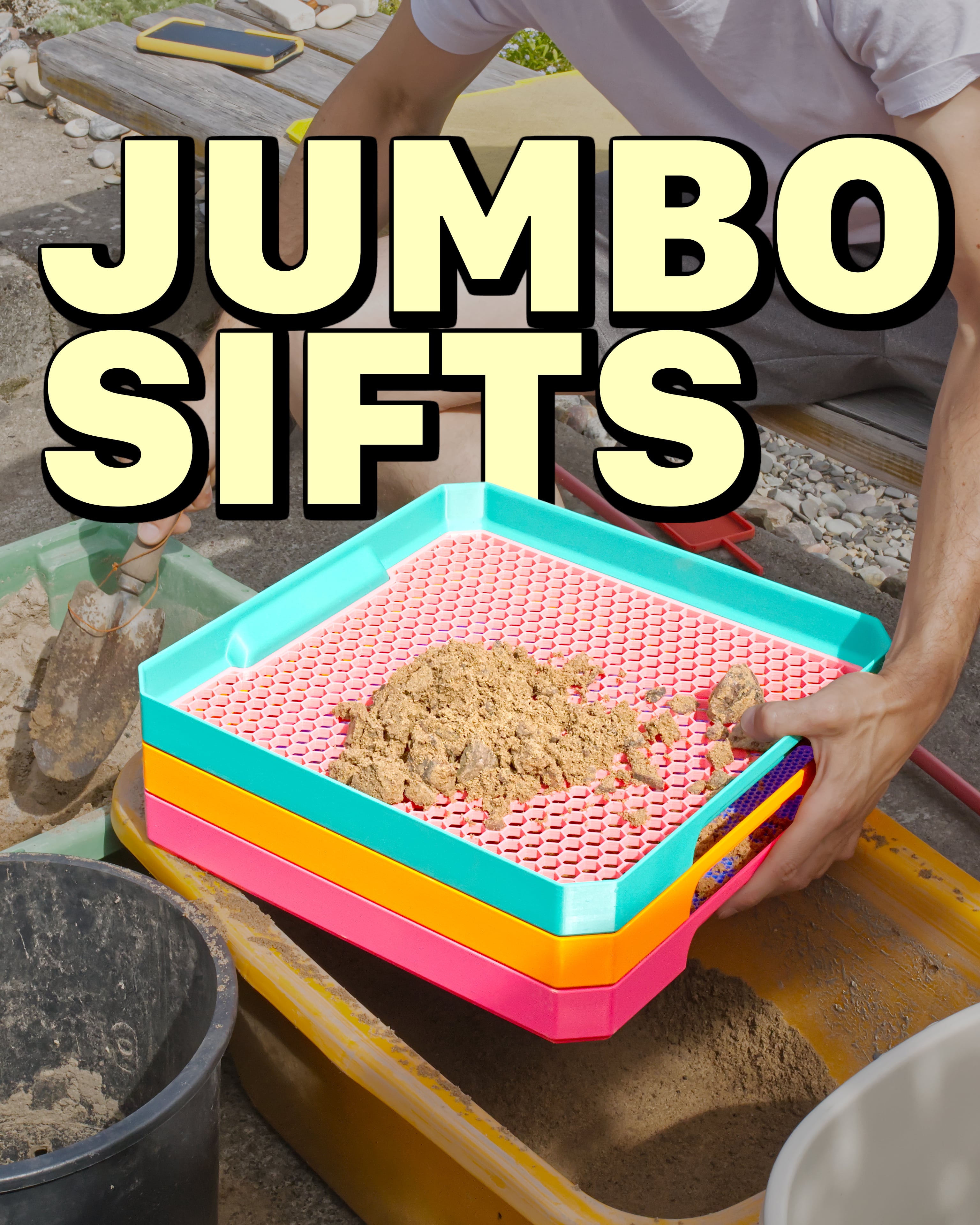
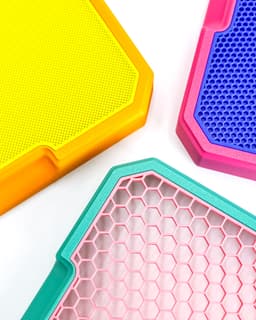
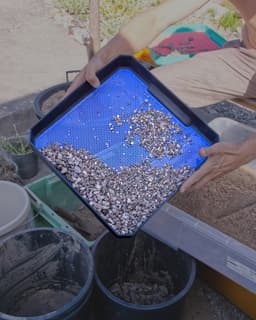
My original Stacking Sieves have been successful, but I wanted a way to sift and sort larger volumes with speed and efficiency, hence this JUMBO Stacking Sieves collection! This system has each sift split into multiple parts, so you can re-fit the frame with different sized meshes and save filament. The meshes can be entirely customized using exposed infill patterns, or the pre-baked select sizes.
Heads up! This is a JUMBO print, requiring a printing bed area of at least 380 x 380 mm. If there's demand I might design a smaller version :)
The basic frame has openings below the handle. You can print the 'Sealed' variants for a completely enclosed frame (for more vigorous shaking), and the 'Tall' variants for greater capacity.
Printing Guidelines
Pre-set 3MF files are included for the Frame, Mesh, and Custom Mesh (Orca slicer). Below are some good starting guidelines, but feel free to make adjustments for your printer and strength needs.
Frame
- 0.16 - 0.24mm layer height
- 0.5mm line width
- 3 walls -4 top and bottom solid shell layers
- 10% cross hatch infill
- 0 sparse infill threshold
- Do not detect narrow internal solid infill
- Disable 'Ensure vertical shell thickness'
Mesh
- 0.24mm layer height
- .7mm outer wall line width
- Check 'Avoid crossing wall'
- 2 wall loops
- 4 top, 3 bottom solid shell layers
- 15% grid infill
- Do not detect narrow internal solid infill
- Disable 'Ensure vertical shell thickness'
- I suggest using custom mesh for hex sizes under 15mm, to save print time and material
Custom Mesh
- Import 'Mesh_Custom_Border' and 'Mesh_Custom_Center' as one combined part
- Same settings as 'Mesh' above but the following object settings for 'Mesh_Custom_Center' :
- 1 Wall Loop
- 0 top and bottom solid shell layers
- Spare infill Line Width '0.7mm'
- Infill direction '0'
- 'Honeycomb' sparse infill pattern ('Grid' for larger square holes instead, Rectilinear for fine square holes).
- You can use the bed grid on the slicer to estimate hole size based on the sparse infill density you choose. For the 0.7mm infill width, the mesh becomes roughly:
- 12% honeycomb = 10mm holes
- 24% honeycomb = 5mm holes
- 25% rectilinear = 2.5mm holes
- 42% rectilinear = 1.5mm holes
I used PLA, but PETG or ASA might be preferable if there will be long term outdoor exposure.
Photographed models were printed on the QIDI Max4 3D Printer.*
*These affiliate links give me a commission on sales at no additional cost to you. Thanks for supporting Make Anything!
JUMBO Stacking Sieves // Supersized Stackable Sift Collection

30mm to 40mm Pendant Light Adaptor

30-60-90 Drafting Triangle // 6 inch + 150mm Version

Drafting Triangle Collection
Gutter Guard // Rain Gutter Debris Filter

EZPZ Screwdriver Bit Clip

IKEA FLISAT Bench TPU Feet // Floor Protector + Grip

EZPZ Pot Spacers // Airflow and Drainage for Plants

EZPZ TPU Cable Clip Collection // Quick, Flexible, Cable Clips

EZPZ Dummy Nail // Damage Free Wall Hanger Collection

EZPZ Wall Hooks Collection // 17 Variations (and counting!)

EZPZ Shelf Hook Collection // Type 1

EZPZ TPU Cable Clip (4mm)

Caliper Undercut Gauge Adaptors

EZPZ Wall Hook // Type A 36mm

EZPZ Small Shelf Hook // Type1

EZPZ Tube to Wall Mount

Moss Dish/Frame for 100mm Chunky Puck Drip Tray

IKEA Bekväm TPU Feet // Floor Protector + Grip

Sink Brush Hanger // TPU Brush Loop Kitchen Organizer
